
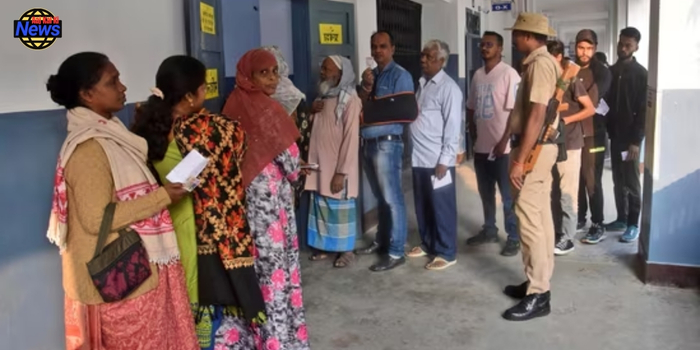
Jharkhand Election 2024: On Wednesday, November 13, voting in 43 assembly constituencies kicked off the election of Jharkhand’s 81-member state legislative assembly. As of 11 a.m. on Wednesday, 43 assembly constituencies had a voter turnout of nearly 29.31 percent. Up until nine in the morning, the Simdega seat had the highest voter turnout (15.09%), followed by Ranchi (12.06%) and Seraikela-Kharsawan (14.62%).
There are 17 general seats, 20 seats set aside for Scheduled Tribes, and 6 seats set aside for Scheduled Castes among the 43 constituencies. Phase two polling for the remaining 38 seats is scheduled for November 20.
Since 950 polling places in 31 constituencies have been designated as “sensitive,” the Election Commission of India (ECI) has implemented complex security measures. Regular polling is scheduled to start at 7 am and run until 5 pm, while the mock poll started at 5:30 am. The “sensitive” booths will close for voting at 4 p.m.
In the first phase, 638 candidates—73 of whom are women—are running for 43 seats. The Bharatiya Janata Party won 25 seats, the Congress won 16, and Hemant Soren’s Jharkhand Mukti Morcha won 30 seats in the last assembly election. Following the most recent Assembly elections, Hemant Soren was appointed chief minister of a government formed by the JMM, Congress, and RJD.
Every polling location has access to all the necessities, such as drinking water, restrooms, and webcasting capabilities. Everything is ready for the polls. Polling places are guarded by CAPF and security. Utkarsh Kumar, the Returning Officer for the Ranchi Assembly constituency, stated that all guidelines established by the Election Commission are being adhered to.
The BJP-led NDA made 25 promises in their electoral manifesto. The promise to “drive out infiltrators” entering the state from Bangladesh is one of them. In addition, the party pledged to protect indigenous groups’ identity by enacting a Uniform Civil Code (UCC).
In addition to concentrating on nine areas, such as education, agriculture, and tribal rights, the ruling Jharkhand Mukti Morcha (JMM) pledged 31 percent reservation for women in government positions. A caste-based census, 250 units of free energy, and the filling of all open government positions within a year were all pledged by the Congress. The Rashtriya Janata Dal (RJD) and CPI (ML) are members of the INDIA-bloc, which also includes both parties.
 Aaj Kal Ki News